


April 18, 2024/FBNQuest Research
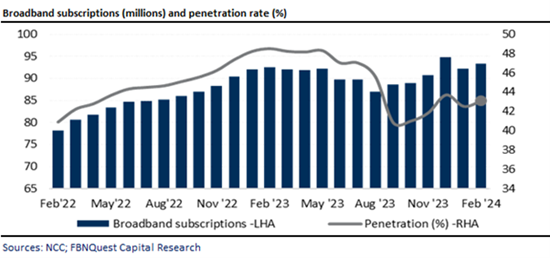
The most recent data from the Nigerian Communication Commission (NCC) shows that Nigeria’s broadband internet connections increased slightly by 1.3% m/m to 93.4 million in Feb ’24. This follows a modest -2.7% m/m decline in January. According to the NCC, mobile broadband accounts for a significant portion (over 99%) of Nigeria’s broadband connections because of the ease and relatively low cost of obtaining mobile lines. Consequently, the monthly rise in broadband connections mirrors the m/m increase in active mobile lines during the period.
- The modest m/m uptick in broadband connections increased the country’s broadband penetration rate to 43.1%, up from 42.5% in the previous month.
- According to NCC, the National Broadband Plan (NBP 2020-2025) seeks to achieve a broadband target of 70% and attain a population coverage of 90% by 2025.
- Consequently, the federal government (FG) must increase the rate by about 27% from its current level to meet its broadband target of 70% next year.
- However, to achieve this ambitious target, the FG would need to address the significant deficit in telecommunications infrastructure in rural areas of the country.
- Notably, operators around the country continue to face several challenges in deploying telecom infrastructural facilities, including security concerns, theft and vandalism of telecom equipment, and issues around states’ issuance of Right of Way (RoW) licenses to telecom operators.
- Another factor in the slow expansion of network facilities is operators’ limited access to foreign exchange (FX). FX scarcity has resulted in GSM operators sourcing FX in the parallel market at exorbitant rates, leading to higher import bill costs.
- In the same vein, the prevailing macroeconomic challenges and FX liquidity concerns have also reduced the telecom industry’s foreign investment.
- To put this into context, the National Bureau of Statistics (NBS) ‘s most recent capital importation data shows that capital inflows into the sector declined by -75% year over year to US$134.8m in 2023.