

April 22, 2024/FBNQuest Research
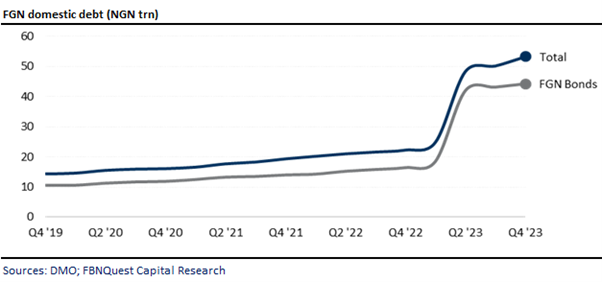
As of Q4 2023, Nigeria’s domestic debt stock rose by 6% q/q to NGN59.1trn, according to the Debt Management Office (DMO). On a y/y basis, total domestic debt more than doubled. The sharp y/y rise in the FGN’s debt profile can be attributed to the inclusion of the securitised ways and means advances of about N22.7trn. Regarding share, the FGN accounts for about 90% of the nation’s total domestic debt stock at N53.3trn, while the balance comprises the Federal Capital Territory’s (FCT) and state governments’ domestic debt.
- In standardised terms, the FGN’s total domestic debt share equates to roughly 23.2% of FY23 GDP. However, if the domestic debt of the states and the FCT is included, this figure rises to 25.7% of 2023 GDP.
- Consistent with FGN’s debt composition, FGN bonds comprise the largest component (83%) of the overall debt stock, down from 86% in Q3 ’23 but higher than 74% in Q4 ’22, respectively.
- In absolute terms, its value share increased to NGN44.3trn in Q4 ‘23, up from NGN43.2trn and NGN16.4trn in Q3 ’23 and Q4 ’22, respectively.
- Apart from the securitised sum, a key driver behind the increase in FGN bonds is the DMO’s record-sales issuance of about NGN5.3trn (ex. non-competitive allotments) worth of papers last year.
- The FG’s increasing reliance on the domestic market to finance budget deficits is due to the tight global financial conditions caused by the restrictive monetary stance of major central banks globally.
- A further breakdown of the FGN’s domestic debt split shows that Nigerian Treasury bills (NTBs) accounted for the second-largest share (12.3%) of the total debt stock.
- The balance comprises promissory notes (2.50%), FGN Sukuk bonds (2.05%), and smaller sums of FGN Savings bonds and Green bonds accounting for (c.0.10%) of the total sum.
- Looking ahead, we anticipate a significant rise in FGN’s domestic debt profile because of its continuous underperformance in revenues relative to rising expenditures and the harsh conditions for obtaining loans from the international debt market.