


April 26, 2024/FBNQuest Research
Recent events highlight the impact of fiscal policies on Nigeria’s economy. Despite its past status as Africa’s largest economy, the Naira devaluation in 2023 saw Nigeria drop to third place, behind Egypt and South Africa. While the IMF forecasts a GDP growth of 3.34% in 2024, it also anticipates Nigeria slipping to the fourth-largest economy by year-end 2024. This shift highlights the vulnerability of Nigeria’s economy to external factors and the importance of effective fiscal management to sustain Nigeria’s economic competitiveness and growth trajectory.
- Against this backdrop, the federal government announced consolidated guidelines for fiscal incentives to revitalise the underperforming oil and gas sector.
- This sector’s importance to the economy is evident. Although it contributes about 4.7% to GDP, it accounts for nearly 90% of merchandise export earnings.
- Given the sector’s economic significance, the new measures are expected to attract investments and increase crude oil production to around 4 million barrels per day over the medium term.
- With an anticipated influx of US$10bn in capital investment over the next 12-18 months, these incentives offer an attractive return for industry projects.
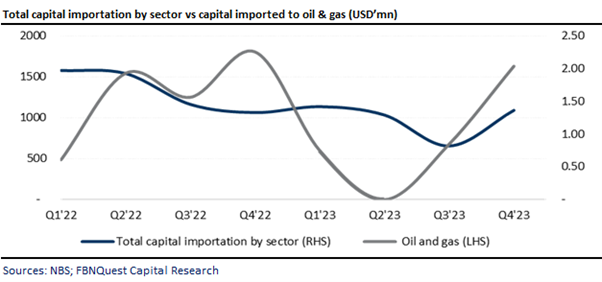
- According to the most recent data from the National Bureau of Statistics, total capital importation into Nigeria increased by +2.6% year on year and 66.3% quarter on quarter to US$1.1bn in Q4 ’24.
- Although capital inflow to the oil and gas sector in Q4 ’23 declined by -9.6% year on year to N2.0bn, it was significantly up by 140.2% quarter on quarter, recovering from no inflow in Q2 ’23.
- As such, this underscores the need for infrastructural reforms and further investments in the sector.
- Furthermore, the incentive guidelines will clarify tax credits and allowances and empower firms in the sector to take advantage of these fiscal incentives.
- By leveraging fiscal and regulatory reforms, Nigeria seeks to establish itself as a competitive player in the global oil and gas market while fostering broader economic development.