
April 30, 2024/FBNQuest Research
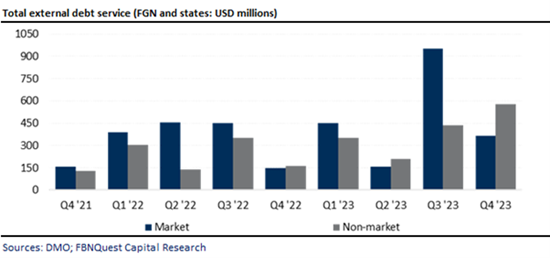
Discussing Nigeria’s debt profile and focusing on the Debt Management Office’s (DMO) external debt service data shows that the federal government of Nigeria’s (FGN’ s) total external debt obligations fell by US$447.5m (-32% q/q) to US$943.2m in Q4 ’23. The total debt service cost comprises market-related debt service payments of US$364m and non-market-related debt service payments of US$579m.
- Compared to the previous quarter, the significant reduction in external debt service payments was mainly due to a marked decline in interest payments of -US$588m or (-62% q/q) for market-related debt.
- On an annualised basis, the FGN’s external debt service payments increased by US$1.1bn to US$3.5bn in FY2023, comprising US$1.9bn and US$1.6bn in market and non-market debt payments, respectively.
- Based on the 2024 budget, the FGN plans an additional external borrowing of N1.8trn and another N1.1trn in loans from concessional lenders.
- Looking ahead, we anticipate a rise in external debt service payments due to the FGN’s plans to raise loans from the commercial debt market this year and an expected increase in borrowings from concessional sources.
- The FG plans to return to the international debt market in June 2024 after a two-year absence caused by high borrowing costs due to restrictive monetary conditions adopted by central banks globally.
- Regarding loans from concessional lenders, the FG recently announced it expects a US$2.2bn loan from the World Bank and low-interest budgetary funding from the African Development Bank (AfDB).
- Although details of the support facility from the AFDB have not yet been provided, the loan from the World Bank will have a 10–20-year moratorium on principal payments and a single-digit interest rate of 1%.
- It’s worth noting that the FGN prefers loans from concessional lenders. This is primarily due to the lower interest rate cost than commercial debt. This strategic choice is a significant aspect of the FGN’s external borrowing strategy and has implications for Nigeria’s debt service payments.