


May 2, 2024/FBNQuest Research
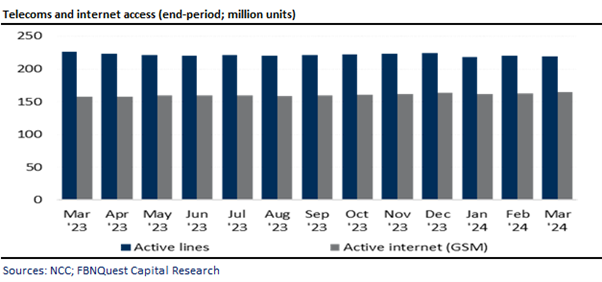
Recent data from the Nigerian Communications Commission (NCC) shows that active mobile lines decreased by a modest 630k or (-0.3% m/m) to 219.3 million in Mar ’24. This follows a slight increase of +0.7% m/m registered in the previous month. The monthly reduction in mobile lines can be primarily attributed to the NIN-SIM linkage policy imposed by the sector’s regulator. As a result, network operators have disconnected mobile lines that have not linked their SIM cards to their NINs.
- However, internet connections grew steadily, increasing by +0.7% m/m to 164.4 million.
- Consequently, the country’s teledensity dropped to 109% in Mar ‘24 from 110% the previous month. In contrast, internet penetration was flat m/m at 82% % based on a population of 200 million.
- The m/m reduction in active mobile lines was mainly caused by 9Mobile, with significant attrition of about 2 million or (-15% m/m) in March, taking its subscriber base to 11.7 million as of end-Mar ’24.
- However, 9Mobile’s net subscriber loss was offset by net additions by all other major GSM network operators in Mar ‘24.
- MTN Nigeria (MTNN), the largest operator by subscriber numbers, recorded the most significant net subscriber gain of about +1.1% m/m or 903k to 81.8 million active users.
- Airtel Nigeria came second with net subscriber additions of almost 321,000 lines, while Globacom recorded a modest accretion of over 88,000 new users.
- Regarding the share composition, the market dynamics remain largely unchanged. MTN Nigeria (MTNN) accounted for the largest share, with c.37.4% of total active subscribers.
- This was closely followed by Airtel and Globacom, which had 28.9% and 28.4% subscriber market shares, respectively.
- 9Mobile, the smallest of the four GSM operators, had a market share of 5.3% as of end-Mar ’24.