

May 30, 2024/FBNQuest Research
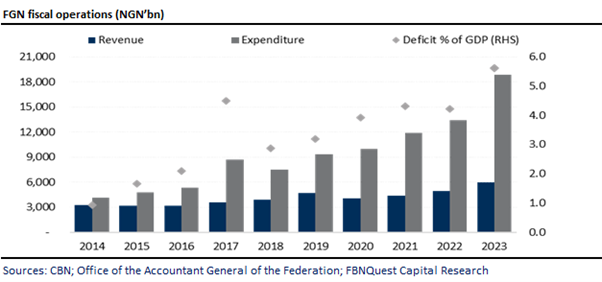
Data from the Central Bank of Nigeria’s (CBN) most recent Quarterly Statistical Bulletin (QSB) shows that the Federal Government of Nigeria (FGN) recorded a fiscal deficit of N3.3trn in Q4 2023. This brings the total fiscal deficit in 2023 to N12.9trn, equivalent to 5.6% of GDP and significantly higher than the 4.2% fiscal deficit recorded in 2022. However, the fiscal deficit for 2023 is lower than the N13.8trn projected in the 2023 budget (including supplementary budgets). However, these figures are provisional and may differ slightly from the more comprehensive data that will be published later by the Budget Office of the Federation.
- The 2023 fiscal deficit reflects the widening gap between the FGN’s revenue and expenditure profiles, with revenue amounting to roughly N6.0trn, far below the N18.8trn in expenditure. The revenue figure also fell short of the 2023 budgeted revenue of N11.0trn.
- The significant revenue shortfall was primarily due to the persistent underperformance of oil revenue. The federation’s gross revenue from crude oil fell to N4.0trn from N4.6trn in 2022, and less than half of the budgeted sum of N9.4trn.
- Total expenditure of N 18.8trn was also below the budgeted sum of N24.8trn, resulting in a lower fiscal deficit. Consequently, the budget was not fully implemented.
- While recurrent expenditure of N14.5trn (76.8% of total expenditure) was almost fully implemented at 91% of the budgeted sum, capital expenditure suffered, amounting to only N4.4trn, which is slightly over half of the budget target of nearly N8.0trn.
- Of particular concern is the rising cost of debt service, which soared to N8.0trn, or 42.5% of total expenditure, up from N5.7trn in 2022 (per CBN data). This significant increase resulted in a debt-to-revenue ratio of 134%.
- Looking ahead, we expect the fiscal space to narrow further due to the rising cost of debt service, driven by a higher FX rate and elevated interest rates, and the anticipated increase in personnel costs after the conclusion of wage negotiations with organised labour.
- We believe that the first step in increasing the FGN’s revenue is to address the issues related to the low productivity of the nation’s oil and gas sector. Increasing crude oil production would also help to address the FX challenges.