December 23, 2024/FBNQuest Research
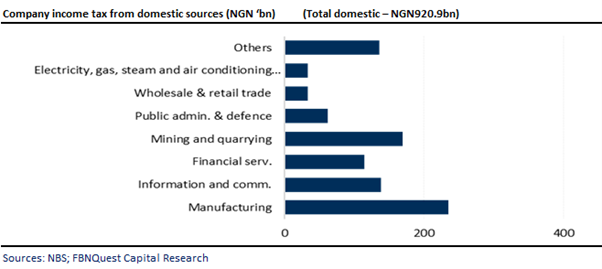
According to the most recent data from the National Bureau of Statistics (NBS) on company income tax (CIT), the total CIT receipts into the federation’s account declined by -28% quarter-on-quarter (QoQ) to N1.8trn in Q3 2024. However, on a year-on-year (YoY) basis, the total tax collection increased mildly by +1% YoY. The considerable reduction in total CIT revenue reflects significant decreases in domestic and foreign CIT collections. CIT receipts from domestic companies, which accounted for about 52% of the overall CIT collections, declined by -32% QoQ to N920.9bn.
- Underscoring the QoQ drop in domestic CIT receipts were weaker contributions from the financial and insurance, information and communication, and transportation and storage sectors.
- In terms of sectoral contribution, the manufacturing sector was the largest contributor, accounting for about 25% or N234.6bn of domestic CIT revenue, while the mining and quarrying sector ranked second with a share contribution of 18% or N169.1bn.
- Despite its QoQ decrease, the information and communication sector came in third, with a revenue generation of N138.8bn or a share of 15% of total domestic CIT receipts.
- Foreign CIT collections fell by -24% QoQ and -22% YoY to N852.3bn, representing about 48% of total CIT collections.
- Broadly speaking, the lower CIT collections mirror the difficult business climate and the significant reduction of consumer demand resulting from elevated inflation, depreciation of the Naira and high interest rates due to the CBN’s sustained tightening policy measures.
- Over the 9M 2024 period, total CIT receipts amounted to N5.2trn, tracking ahead of the CIT revenue collections of N3.3trn projected in the 2024 budget.
- Highlights from the 2025 budget proposal estimate a CIT revenue collection of about N5.7trn.
- While this target is realistic, achieving it will require improving the operating business environment and revamping the nation’s tax administration system to enhance revenue collections (see chart below)