

January 2, 2025/FBNQuest Research
Culled: Proshare
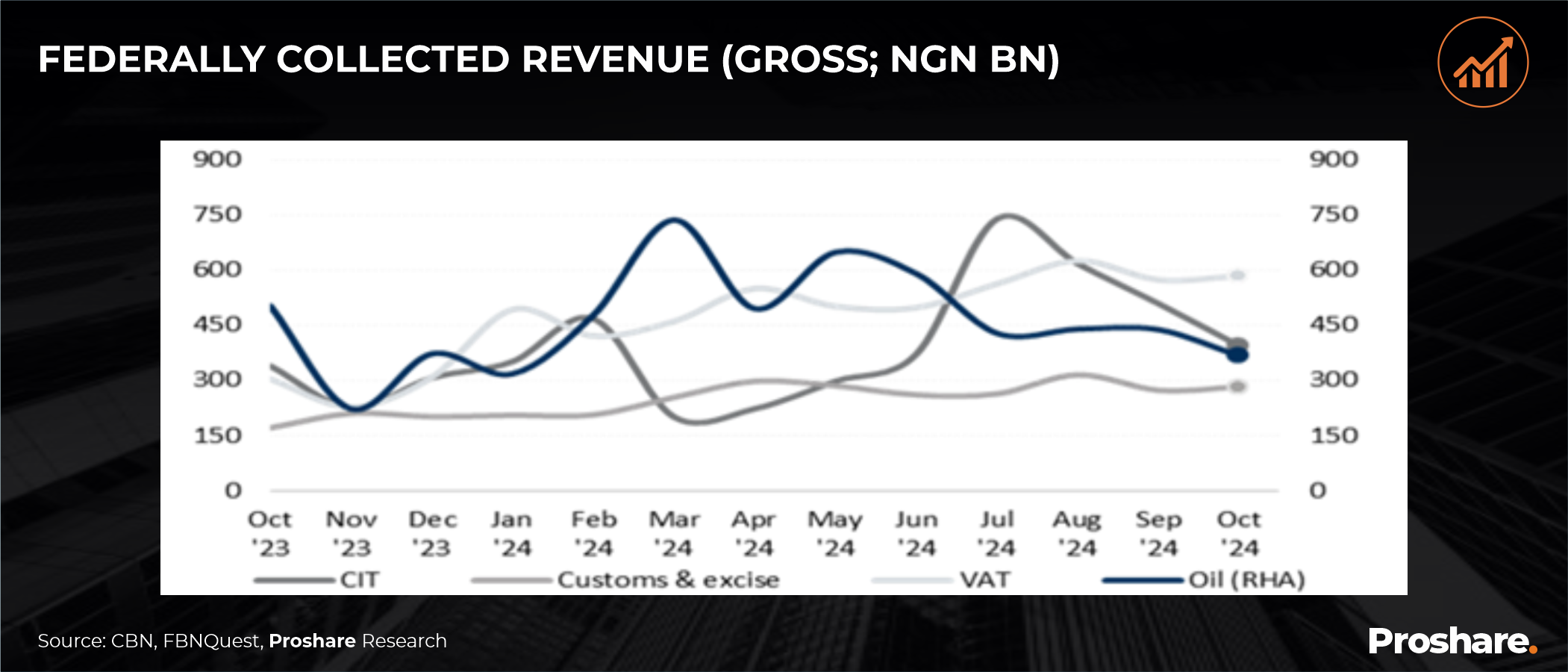
The Central Bank Nigeria’s (CBN) recent monthly economic report, notes that the gross federally collected revenue for distribution to the three tiers of government fell by -8% month-on-month (MoM) to roughly N2.0trn in October 2024. Conversely, in terms of year-on-year (YoY) comparison, the figure increased by +11% YoY. Gross revenue fell by -34% below the N3.0trn pro-rata monthly budget target. After deductions transfers, and some additional revenue, mainly from exchange rate gains, the balance left for distribution to the three tiers of government amounted to N1.3trn.
- In terms of composition, oil and non-oil revenue respectively contributed 18% and 82%, to total federally collected revenue.
- Although both revenue verticals declined m/m, oil revenue, which fell by -16% MoM to N366bn and was -79% below the anticipated monthly benchmark, was the primary driver of the m/m decline in the federation’s gross revenue.
- The decline in oil revenue was primarily attributable to reduced income from petroleum profits tax down -29% MoM and production shut-ins caused by ageing oil pipeline infrastructure.
- Although total non-oil revenue decreased by -6% MoM to N1.7trn, it still came in around 32% above the monthly budget target of N1.2trn.
- Regarding the key components within non-oil revenue, value-added tax (VAT) increased slightly by +2% MoM to N584bn, well above the monthly budget benchmark of N330bn.
- Similarly, collections from customs and excise duties increased by +3% MoM to N283bn, roughly 18% higher than the budgeted monthly amount.
- Conversely, the total take from companies’ income tax (CIT) decreased by -23% MoM to N395bn. However, it still exceeded the projected monthly budget of N271bn.
- The sustained robust performance of non-oil revenue reflects the favourable impact of ongoing fiscal reforms and efforts to diversify the federation’s revenue base.
- The discrepancy between actual revenue receipts and budget forecasts underscores the challenges in oil revenue and the Nigerian economy’s ongoing fiscal pressures.