




Tuesday, 9 Nov 2010
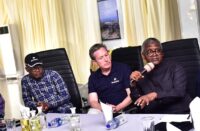
The tripartite meeting between the Federal Government, state governors and representatives of the organised labour over the N18,000 minimum wage ended in a deadlock in Abuja on Monday.
With the development, the three-day warning strike by workers will begin on Wednesday as scheduled, according to organised labour.
“The strike is very much on course. We just ended a meeting with Vice-President, Namadi Sambo. But unfortunately, nothing new was put on the table. So we are fully mobilised for Wednesday,†the Chairman of the Nigeria Labour Congress Committee on National Strike, Mr. Promise Adewusi, told THE PUNCH in Abuja.
Before Adewusi spoke, the Labour and Civil Society Coalition maintained in Lagos that workers would go ahead with the strike unless the National Assembly passed a bill on the minimum wage.
LASCO comprises the Nigeria Labour Congress, the Trade Union Congress of Nigeria and the Joint Action Forum.
Also on Monday, a formidable affiliate of TUC, the Petroleum and Natural Gas Senior Staff Association of Nigeria, directed its members to participate fully in the strike.
THE PUNCH learnt that before the meeting with the union leaders in the vice-president’s office, the National Council of State sub-committee first deliberated on how to stop the strike.
The Sambo-led sub- committee has Governors Adams Oshiomhole (Edo), Babatunde Fashola (Lagos), Sule Lamido (Jigawa), Sullivan Chime (Enugu) and Gabriel Suswan (Benue) as members.
Adewusi and the President-General of the TUC, Mr. Peter Esele, led the labour team that included Mr. Peter Adeyemi, Mr. Isah Aremu and Mr. Iduh Odah.
Adewusi said no progress was made at the meeting because the government’s team, rather than heed labour’s demand, opted to ask for more time.
Also, Odah, who is the acting head of information of the NLC, said that the deliberations ended in a stalemate because the government only pleaded with labour to call off the strike.
He said, “Labour did not make any demand we needn’t make any demands because the issues were well known before we got to the meeting with the government.
“We decided to opt for the strike option because the Federal Government only went to the meeting to plead with us to shelve the strike and we said no. It is not as if labour made new demands. That is not it, the issues are well known.â€ÂÂ
But Oshiomhole, who briefed journalists , assured that the government would speed up the process of approving the minimum wage.
The governor said the labour leaders believed that government was slow in acting on their demand, adding that the council of state would hold an emergency meeting on November 25 on the issue.
He said, “Government has now realised that we have to act fast. The meeting of the council of state has been slated for November 25 and the National Council of State will finalise the decision (on the minimum wage). The report will be forwarded to the National Assembly.â€ÂÂ
Oshiomhole added that he was hopeful that the National Assembly, which is also represented in the NCS, would fast-track the process of passing the bill on the minimum wage.
“Everything concerning the minimum wage will be finalised at that (NCS) meeting and it will be submitted to the National Assembly to give legal backing to the report.â€ÂÂ
“If the NLC and TUC had seen evidence that something was being done, they would probably not have issued the ultimatum,†he added.
In Lagos, the General Secretary, Nigeria Union of Electricity Employees, Mr. Joe Ajaero, said at a news conference by LASCO that workers in the public and private sectors had been directed to stay away from their offices beginning from Wednesday.
“The only condition that will stop this action is the passage of the law for minimum wage between now and tomorrow,’’ Ajaero said.
He wondered why a bill on the new wage that ought to take the National Assembly only a few hours to pass was being delayed.
Ajaero said, “The only condition to stop the strike is the passage of the bill between now or tomorrow. Alhaji Shehu Shagari’s regime did it in 1981 within hours. President Goodluck Jonathan can do it too.
“Various laws have been passed in the past within hours. It only takes amendment. We don’t understand why the government cannot uphold a decision which enjoys joint authorship.â€ÂÂ
He added that after the warning strike, labour would strategise on when to embark on a total work boycott if the government failed to accede to workers’ demand.
Mr. Abiodun Ogunade, who represented the TUC at the news conference, appealed to the Federal Government to implement the wage for workers.
The Deputy Secretary, Nigeria Union of Road Transport Workers, Lagos State, Mr. Paul Oginni, said all drivers nationwide would be involved in the strike.
Also, PENGASSAN said in Abuja that it had directed its members to proceed on the strike, in compliance with the TUC’s.
The association, in a letter titled, ‘Three-Day Warning Strike on National Minimum Wage Implementation,’ quoted a memo by Esele and the TUC General Secretary, Mr. John Kolawole, that frowned at the delay in the implementation of the minimum wage , the crisis in South-East universities, insecurity in the country and the planned privatisation of the power sector.
The November 5, 2010 letter by the PENGASSAN General Secretary, Mr. Bayo Ogwoshile, reads in part, “The Central Working Committee of the TUC, at the end of its exhaustive emergency meeting on November 3, 2010, resolved that all affiliates of the congress should direct their appropriate organs and advise all members to observe a three -day nationwide warning strike on Wednesday, November 10 and end on Friday, November 12, to impress on the federal and state governments to demonstrate their commitment to the national minimum wage.
“Consequently, PENGASSAN as an affiliate of TUC hereby directs all her zonal offices and branches to advise all members to accordingly observe the three-day warning strike. However, essential services shall be maintained through the period of this action.â€ÂÂ
In his remarks, the National Coordinator of LASCO, Dr. Dipo Fashina, said the implementation of the new minimum wage was long overdue.
He said, “The minimum wage is not a fancy wage. It is what workers will have to make the barest minimum living with – to feed the family at the minimum level and pay house rent. It is also to cater to education, health and transport of the family. It is supposed to enable the worker to get the minimum functions of life.â€ÂÂ
Fashina, who described the N18,000 demand as ‘a starvation wage,’ said, “ No legislator earns less than N20m per month in Nigeria.â€ÂÂ
Wondering if Nigerian workers were ‘less human,’ he said that no one should blame them for the looming strike.
He appealed to Nigerians to wake up and “join in the struggle to make sure they(workers) have a decent living.â€ÂÂ
Fashina said, “Our rulers are gathering more money for themselves, yet when it comes to workers, they say give us more time. Governors trying to scuttle the minimum wage should know that workers are human beings and that they deserve a decent living.â€ÂÂ
But the Nigerian Employees Consultative Association has called on the government to avert the strike by acting quickly.
The President of the association, Chief Richard Uche, told one of our correspondents on the telephone, that a three-day strike would cripple the economy, which ‘is already struggling.’
“Do you know what it means to lose three days productivity, especially for an economy that is already struggling? Is that the way the country is going to become one of the top 20 countries in year 2020?†he said.
Meanwhile, many residents of Port Harcourt, Rivers State rushed to the banks to withdraw money, in anticipation of a strike.
A resident, who gave his name as Austin Amadi, said, “ I do not want to take chances. It is better to keep money at home while the strike is on. As a family man, I need to take care of my people.’’
Another customer, Mrs Florence Ekeh, told the News Agency of Nigeria that she was in the bank to get some money because of the strike.
Ekeh said, “I support the strike. It appears our leaders do not care about workers’ welfare. Is it not an irony that welfare matters that affect politicians do not waste time in its implementation? Why should workers’ welfare drag on for ages before it is implemented?â€ÂÂ
Source: Punch

