




November 4, 2019/Cordros Report
Equities
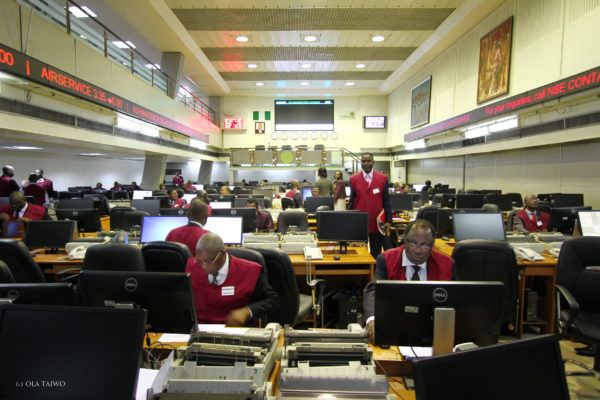
Nigeria’s equities market began the week on a positive note, as the benchmark index widened by 0.41% to 26,401.06 points, driven by gains in the banking stocks. Consequently, the Month-to-Date and Year-to-Date losses moderated to -4.45% and -16.00% respectively.
Also, the total volume of trades increased by 45.90% to 368.18 million units, valued at NGN2.77 billion and exchanged in 3,473 deals. ACCESS was the most traded stock by volume at 80.57 million units while ZENITHBANK was the most traded by value at NGN777.18 million.
On sector performances, gains in the Banking (+2.49%), and Industrial Goods (+0.65) indices outweighed losses in the Consumer Goods (-1.27%), Insurance (-0.73%) and Oil & Gas (-0.12) indices.
Market sentiment, as measured by market breadth, was positive at (1.5x) as 18 tickers recorded gains relative to 12 losers. CHAMPION (+10.00%) and HONYFLOUR (+9.47%) recorded the largest gains, while FIDSON (-10.00%) and UNILEVER (-9.93%) recorded the largest declines.
Currency
The naira traded flat against the US dollar at NGN360.00/USD in the parallel market, while it appreciated by 0.06% to NGN362.55/USD at the I&E FX window.
Money market & fixed income
The overnight lending rate dipped by 21bps to 3.86%, as system liquidity became strained ahead of the upcoming CBN FX auction across the Wholesale, Invisibles & SME segments.
Activities in the Treasury bills market sustained its bearish trend, as the average yield increased by 20bps to 12.62%. Yields expanded across the short (+12bps), mid (+11bps), and long (+32bps) segments of the curve, following sell-offs of the 10DTM (+74bps), 157DTM (+47bps) and 346DTM (+267bps) instruments, respectively.
Trading in the Treasury bonds market was mixed, albeit with a bearish tilt, as the average yield expanded marginally by 1bp to 13.21%. Yields expanded across the short (+13bps) and long (+1bp) segments of the curve, following sell-offs of the JUL-2021 (+42bps) and JUL-2034 (+1bp) bonds, respectively. On the flip side, buying interests in the FEB-2028 (-18bps) bond, led to yield contraction at the mid (-9bps) segment of the curve.
Click here to read full PDF copy of report

