


August 30, 2021/DMO
Background
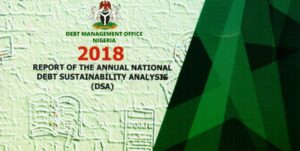
The Debt Management Office (DMO), in collaboration with key stakeholders, conducts annual Debt Sustainability Analysis (DSA) to evaluate the level and risks associated with Public Debt.
The 2018 exercise was conducted from October 30 to November 9, 2018 in partnership with the following institutions: Federal Ministry of Finance (FMF), Federal Ministry of Budget and National Planning (FMBNP), Central Bank of Nigeria (CBN), Budget Office of the Federation (BOF), National Bureau of Statistics (NBS), Office of the Accountant-General of the Federation (OAGF), Federal Inland Revenue Services (FIRS) and the Nigeria Customs Service (NCS). The West African Institute for Financial and Economic Management (WAIFEM), provided technical support.
Policy and Macroeconomic Developments
Global Environment
Global economic activities were weakened in 2018: by restrictive trade policies between the United States and China, two countries that account for approximately 40 percent of the world’s Gross Domestic Product (GDP). The impact of the trade row on the economies of the two countries is mixed, with growth projected to be higher in the United States by 2.9 percent in 2018 compared to 2.2 percent in 2017, while China is estimated to grow by 6.6 percent from 6.9 percent in 2017.
In the Euro Area, the top economies, Germany, France, Italy and Spain that account for about 13 percent of global GDP, are predicted to experience sluggish growth in 2018. While growth in the entire Euro Area is estimated at 1.8 percent compared to 2.4 percent in 2017, Germany is expected to grow 1.5 percent in 2018 as against 2.5 percent in 2017, France 1.5 percent compared to 2.3 percent in 2017, Italy 1.0% from 1.6 percent in 2017, and Spain 2.5 percent as against 3.0 percent in 2017. The United Kingdom, still faced with the Brexit issues, is estimated to grow 1.4 percent from 1.8 percent in 2017.
Growth in Sub-Saharan Africa is projected to remain flat at 2.9 percent. However, the two top economies in the region, Nigeria and South Africa that account for about 0.9 percent of global GDP are projected to have mixed performance in 2018. While Nigeria is expected to record 2.9 percent, growth compared with 0.8 percent in 2017. South Africa’s economy is projected to expand by only 0.8 percent in 2018 from 1.3 percent in 2017.
Overall, the International Monetary Fund (IMF) estimates that the global economy will expand by 3.7 percent in 2018, lower than the 3.8 percent recorded in 2017. Advanced Economies are to experience 2.3 percent growth as against 2.4 percent in 2017, while Emerging Market and Developing Economies will grow by 4.6 percent from 4.7 percent in 2017. The global economy will in the medium term continue to be affected by the protracted trade matter between the United States and China, even though both countries are making effort to resolve the impasse and the Brexit issue in the UK.
Domestic Environment
Policy Issues
In fiscal year 2018, the Federal Government continued with the implementation of sectoral programmer and projects as outlined in the Economic Recovery and Growth Plan (ERGP) 2017-2020. Macro-fiscal management was enhanced as monetary authorities achieved price and exchange rate stability, while convergence of the different exchange rates remains a priority for the CBN. For example, the premium between the Interbank and Bureau D’ Change Exchange
Rates narrowed to 17.40 percent in Q3 2018 from 18.59 percent in Q1 2018 but increased to 18.20 percent in Q4 2018.
The restraint of access to foreign exchange market of 41 items that can be produced locally aided local production in 2018, while the Anchor Borrowers’ Programme moved the country away from a net importer of rice to a key producer. Specifically, as at October 2018, about 862,069 farmers benefited from the programme, which had generated almost 2,502,675 jobs across the country.
The positive stance expressed by the monetary authorities on the effective implementation of the ERGP and the 2018 capital Budget indicated how fiscal policy contributed to the decision-making process of the CBN in 2018.
On their part, fiscal policy managers maintained fiscal discipline as emphasis continued on the funding of critical infrastructure projects. For example, funding selected capital projects in the 2018 Budget through the Sukuk Bond Issuance of N1i00 billion guaranteed efficiency in the construction and rehabilitation of road projects across each of the 6 Geo-political zones in the country. In addition, Mr. President on February 25, 2018 established the Presidential Infrastructure Development Fund (PIDF), the avenue through which the Nigeria Sovereign Investment Authority (NSIA) is investing in critical infrastructure projects nationwide. Another innovative means of funding critical infrastructure introduced recently is the Road Infrastructure Development and Refurbishment Investment Tax Credit Scheme. The strategy herein is that private sector participants will utilize project costs incurred in construction or refurbishment of Eligible Roads as a credit against Companies Income Tax payable.
On the revenue side, production shortfalls and unpredictable oil prices meant that forecasted oil revenues were not achieved in 2018. Specifically, the projected gross oil and gas federation revenues for 2018 was N7,618.07 billion and of this amount N5,078.71 billion was expected in the first 8 months of the year. However, only N3,603.25 billion was realized between January and August, indicating a shortfall of N1,475.46 billion or 29 percent. To enhance future oil revenue inflows, Government has continued to take measures to boost oil production, including ensuring stability in the Niger Delta area. Government fully understands the volatility associated with oil prices and the unpredictability of the Niger Delta region. Thus, efforts aimed at boosting non-oil revenues were stepped up in 2018 because all the components (Corporate Tax, VAT, Customs, and Tax Amnesty) under-performed by 28 percent in the first 8 months of the year.
Two important steps have therefore been taken to boost non-oil revenue generation. First, there is an Approved Revenue Performance Management Framework for Government Owned Enterprises (GOEs), and the goal is to raise revenue generation and the associated remittances to the treasury. The mechanisms for achieving the objective of the Framework are the introduction of Performance Contracts for Chief Executive Officers and other Management Staff of the GOEs, Expenditure Controls, Budgeting and Financial Reporting Requirements, Financial Oversight, and Amendment of Establishment Acts of some GOEs. second, the Strategic Revenue Growth Initiative (SRGI) finalized in 2018 but recently mapublic, is aimed at establishing sustainable revenue generation. In particular, key revenue institutions like the Federal Inland Revenue Service (FIRS) and the Nigeria Custom Service have developed innovative ways by which they will enhance their revenue generation and remittance to the treasury.
Click here to read full PDF copy of report

