| The International Monetary and Financial Committee (IMFC) released its communiqué on Thursday, echoing concerns over an increasing divergence among countries as the global economic recovery continues. The IMFC called for strong international cooperation and immediate action to expedite vaccinations, a careful calibration of domestic policies, and acceleration of climate action and other transformational reforms. “We agreed to take steps to reach the global goals of vaccinating at least 40% of the population in all countries by the end of 2021 and 70% by mid-2022,” said IMFC Chair Magdalena Andersson, who currently serves as Sweden’s Finance Minister. The IMFC also welcomed a historic allocation of Special Drawing Rights and supported the IMF’s efforts to seek options for allowing countries with stronger economic positions to distribute some of their shares of the reserve asset to benefit low-income and vulnerable middle-income countries. 📺 Watch the IMFC press conference featuring Andersson and IMF Managing Director Kristalina Georgieva. | 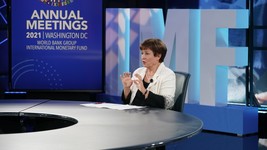 The global recovery continues amid uncertainty on when the pandemic will be overcome. With unequal vaccine access, inflation pressures, and still elevated unemployment, policies face multiple challenges. IMF Managing Director Kristalina Georgieva joined Kristin J. Forbes, Professor, Global Economics and Management, MIT; Mo Ibrahim, Founder, Mo Ibrahim Foundation; and Min Zhu, Chairman, National Institute of Financial Research at Tsinghua university, for a debate on the global economy. Georgieva made an appeal for a more comprehensive approach to resilience in the form of more resilient people, a resilient planet and resilient institutions. “I expect to see us taking more of that concept of resilience–in a fast-moving, shock-prone world–to heart,” she said. Watch the event. |
At the capacity development talk on Engineering the Green Transformation ahead of COP26, the IMF and some of its development partners from Germany and the United States showcased how they build technical and institutional capacity to implement climate-friendly economic policies. Martin Kipping from the German Federal Ministry for Economic Cooperation and Development mainly focused on macroeconomic and fiscal frameworks. Sashi Jayatileke from USAID explained how the agency works to promote the uptake of climate finance globally. The IMF’s Chol Suphachalasai gave an overview of the way in which the IMF scales up climate in capacity development, from the Public Investment Management Assessment to the Climate Change Indicators Dashboard. During this event, the IMF also announced that it would host a signing ceremony on October 18 to welcome USAID as a partner of its regional center for the Caribbean, where USAID will support climate-related technical assistance, among other priority topics. Watch the event. |
|
| TODAY’S AGENDAFRIDAY, OCTOBER 14, 202111:00 AM – 11:45 AM ETUnlocking Access to Climate Finance SPEAKERS: Natalija Novta, Asia and Pacific Department, IMF; Gemma Preston, Fiscal Affairs Department, IMF Reaching Net Zero Emissions SPEAKER: Gregor Schwerhoff, Research Department, IMF Climate Change Challenges in Latin America and the Caribbean SPEAKERS: Chao He, Western Hemisphere Department, IMF; Diane C. Kostroch, Western Hemisphere Department, IMF 
1:30 PM – 2:15 PM ETSPEAKERS: Kristalina Georgieva, Managing Director, IMF; Benoît Cœuré, Head, BIS Innovation Hub; Eswar Prasad, Professor, Cornell University; Senior Fellow, Brookings Institution MODERATOR: Martin Wolf, Chief Economics Commentator at the Financial Times
| 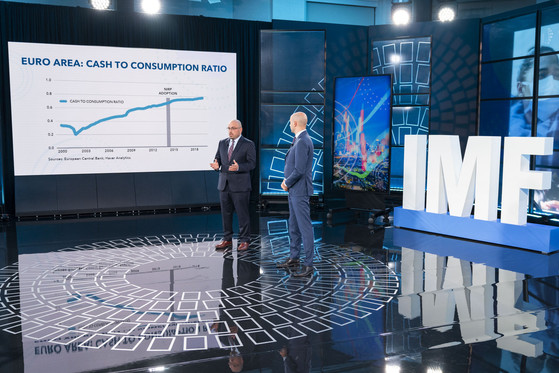
Negative interest rates were the subject of one Analytical Corner presentation from IMF economists Marco Casiraghi and Gunes Kamber. They concluded that central banks should include or maintain the use of negative interest rates as part of their toolkit. “Overall most of the potential side effects associated with negative interest rates have failed to materialize or have turned out to be less relevant than expected,” said Kamber. In other presentations, IMF economists Jehann Jack and Tarak Jardak discussed solutions for resolving bad loans in sub-Saharan Africa. The IMF’s Ehsan Ebrahimy presented research on what the decline in real rates and increasing government debt means for debt sustainability. Finally, the IMF’s Maksym Markevych talked about financial integrity screening of cross-border financial flows. Watch all the presentations.  Flagship Report RewindWorld Economic Outlook–Recovery During a Pandemic: The global recovery continues but momentum has weakened, hobbled by the pandemic. Health concerns, supply disruptions, and price pressures continue. The global economy is projected to grow 5.9 percent in 2021 and 4.9 percent in 2022, 0.1 percentage point lower for 2021 than in the July forecast. Read the full report, which includes analytical chapters on inflation and the economic importance of research and innovation. Global Financial Stability Report–COVID-19, Crypto, and Climate: Amid the prolonged and painful pandemic, risks to global financial stability have remained contained—so far. But with economic optimism fading, and with financial vulnerabilities intensifying, this is a time for careful policy calibration. Uncertainty is especially intense because of the persistent pandemic-stricken atmosphere where society confronts the challenges inherent in “the three Cs”: COVID-19, crypto, and climate change. Read the full report, which includes analytical chapters on the crypto ecosystem and green investment funds. Fiscal Monitor–Fiscal Policy for an Uncertain World: The pandemic will leave a lasting mark on inequality, poverty, and government finances. The global pandemic has trigged a 14% jump in global debt, to a record high of $226 trillion. In advanced economies, fiscal policy remains supportive of economic activity and employment but in emerging markets and low-income developing countries the crisis is expected to have long-lasting negative impacts and lead to a reduction in fiscal revenues relative to pre-pandemic trends. Read the full report, which includes an analytical chapter on strengthening the credibility of public finances. |
| 
Other Highlights of the WeekReimagining the Workplace for Women: “You don’t value what you don’t pay for and so many mothers are treated like martyrs. We’re doing the unpaid work and we’re not being paid for it. That work is not being valued and no one seems to care,” said Reshma Saujani, founder of the Marshall Plan for Moms, a plan to support mothers through direct payments and other polices. She spoke at Monday’s IMF Inspired event. Ending the Pandemic: The heads of the IMF, World Bank Group, World Health Organization and World Trade Organization convened for an event Tuesday to discuss accelerating global access to vaccines, therapeutics, and diagnostics, and how to measure this progress. Countdown to COP26: Ahead of the UN Climate Change Conference (COP26) starting at the end of the month, COP26 President Alok Sharma participated in a keynote conversation Wednesday where he urged countries to continue to put forward ambitious plans for cutting emissions and reaching a net-zero goal by mid-century. |
TOMORROW’S AGENDASATURDAY, OCTOBER 15, 202110:00 AM – 11:00 AM ETSPEAKER: Christine Lagarde, President, European Central Bank MODERATOR: Guillermo Ortiz, Chairman, The Per Jacobsson Foundation |