

November 29, 2022/CSL Research
According to a Bloomberg news report, the government of Ghana plans to ask holders of its international bonds to accept losses of as much as 30% on the principal and forgo some interest payments as part of a debt-sustainability plan to qualify for a loan from the International Monetary Fund. The Deputy Minister of Finance, John Kumah, also noted that holders of domestic bonds will be asked to forfeit some interest payments. In addition to principal cuts, the government is looking to suspend interest payments on foreign bonds for three years.
Domestic debt investors would be asked to exchange their existing securities for new ones that may offer a zero coupon in the first year, 5% in the second and 10% in the third year. The debt restructuring is intended to help Ghana meet sustainability requirements to qualify for the International Monetary Fund (IMF) US$3bn bailout it has been negotiating since September, and possibly reach a staff-level agreement with the Washington-based lender by year-end. The government has set up a committee to start a “backstage engagement” with bondholders.
The report further noted that Ghana’s vice president, Mahamudu Bawumia, announced separately that the government is considering adopting a policy to use gold to purchase oil products – an effort to stem demand for foreign exchange by crude importers and support the cedi. The currency has depreciated 57% this year, fueling inflation that topped 40% last month.Ghana has been shut out of international debt market amid a selloff of its dollar bonds that lifted yields to distressed levels. The cedi is the world’s worst-performing currency against the dollar this year, raising the cost of servicing the loans.
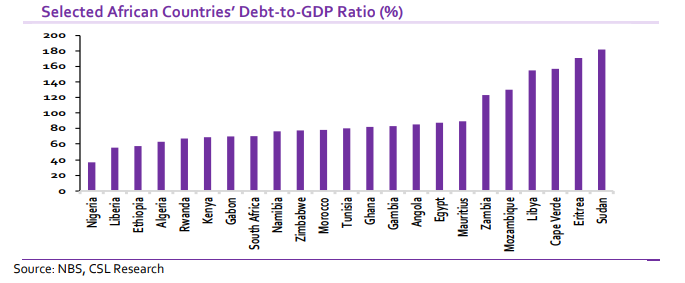
Besides Ghana, several other countries have been flagged to be at risk of default. While Russia & Sri Lanka both defaulted, El Salvador, Tunisia, Parkistan, Egypt, Kenya, Argentina, Ukraine, Bahrain, Namibia, and Brazil take the lead, considering their Debt to GDP and Interest to GDP ratios. We note that Nigeria, with Debt to GDP ratio of 37.4% and Interest to GDP ratio of 2.3% appears to be in good standing. However, most developing economies have had their credit ratings downgraded to non-investment grade.