
April 12, 2023/FBNQuest
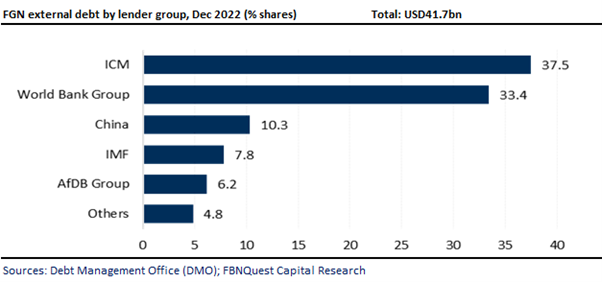
According to the Debt Management Office’s (DMO) most recent quarterly data series on Nigeria’s public debt, the country’s stock of external debt increased by USD2.0bn (+5% q/q) from the previous quarter to USD 41.7bn in Q4 ’22. Measured on a y/y basis, the rise in external debt is greater at c.USD3.3bn, representing a growth of 9% y/y. Although the federal government of Nigeria (FGN) accounts for the majority (89%) of the total external debt, the balance comprises debt owed by state governments to multilateral and bilateral lenders, which are guaranteed by the FGN. The total public debt is equivalent to c.9.4% of 2022 GDP.
A breakdown of the overall debt balance shows that over 48% of the loans are due to multilateral lenders such as the World Bank, International Monetary Fund (IMF), and African Development Bank on favourable concessional terms.
The ratio rises to 61% if loans owed to bilateral lenders are included. Consequently, external debt due to commercial lenders accounted for just around 38% of the total external debt balance.
The bulk of the increase in external debt was due to a rise in loans from the World Bank. For context, loans from the Bank were up by about USD1.4bn q/q, representing roughly 70% of the total q/q increase. They also accounted for c.47% of the total y/y rise in external debt.
Other notable contributors to the increase in external debt q/q are China and the IMF, which accounted for 10% and 8% respectively of the overall increase.
Debt owed to commercial lenders remained unchanged q/q at US15.6bn, reflecting tight financial market conditions globally. This is because of an aggressive monetary tightening by most central banks around the world.
By way of illustration, secondary market yields for Nigerian Eurobonds are up by an average of around 400bps compared with a year ago.
We see, from the 2023 budget, that the FG expects to fund part of its NGN10.8trn fiscal deficit via new foreign borrowings of NGN1.76trn (USD3.8bn), and multilateral and bilateral loans of NGN1.77trn.
Looking ahead, sourcing new loans from commercial sources, such as Eurobonds will remain challenging due to the elevated interest rate environment and the tight financial market conditions globally.