

December 12, 2023/FBNQuest Research
The National Bureau of Statistics (NBS) most recent quarterly report on value-added-tax (VAT) shows that the federation’s collections from VAT increased by 21% q/q and 52% y/y to NGN948.1bn in Q3 ’23. Domestic (non-import) VAT was the largest contributor to the gross receipts, amounting to NGN522.1bn or 55% of the total figure. Domestic VAT was also up by 2% q/q and 42% y/y, respectively.
Receipts from imports, which experienced the most significant growth during the quarter, were the second largest source of VAT revenue. Imports VAT saw a marked increase of 75% q/q to NGN221.4bn. On a y/y basis, it was up by 63% y/y.
The notable increase in revenue from VAT imports can be attributed to the CBN’s upward review of the exchange rate for duty and tariffs paid on items imported into the country.
Foreign (non-import) VAT, which represents 22% of total VAT receipts, increased by 43% q/q and 68% y/y to NGN204.6bn.
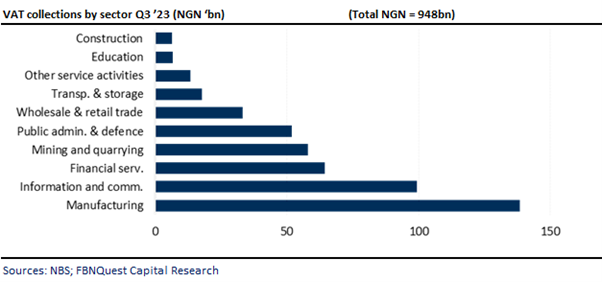
With respect to sectoral distribution within the domestic VAT, the manufacturing sector remained the largest source of revenue contribution. However, it declined by -9% q/q to NGN138.4bn. In contrast, collections from the sector were up by 46% y/y.
ICT came in as the second-largest contributor to the total VAT revenue at NGN99.4bn, accounting for 19% of domestic VAT collections and 10% of total VAT receipts. Revenue from the sector fell by -8% q/q. However, it increased by 46% y/y.
Financial and insurance services emerged third at 12% and c.7% of domestic and total VAT revenue, respectively. VAT receipts from the sector more than doubled y/y to NGN64.3bn.
The sector’s GDP has continued to deliver impressive growth in recent quarters. The sector’s GDP expanded by 28.2% in Q3 ’23, up from 26.8% in the previous quarter.
Despite the increase in VAT revenue, Nigeria’s revenue-to-GDP ratio of less than 10% is considerably low compared to other emerging and developing countries.
That said, the current administration has continued to review and implement tax policies to improve its revenue generation in a bid to increase the country’s revenue-to-GDP ratio from less than 10% to 18% by 2026.