




March 21, 2024/CSL Research
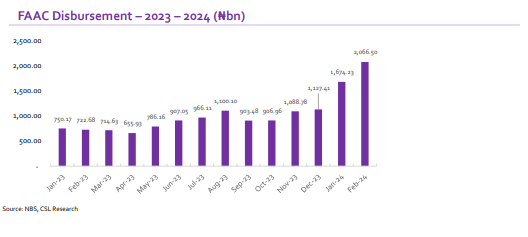
According to the Nigerian Bureau of Statistics (NBS), the Federal Account Allocation Committee (FAAC) distributed N2.07tn in February 2024 from the total revenue collected in January 2024 among the Federal Government, States, and Local Government Councils. The total amount distributed in February 2024 came in 23.4% m/m higher than the N1.67tn distributed in January 2024.
This revenue allocation comprised of N463.08bn in statutory revenue, N391.78bn in distributable value added tax (VAT) revenue, N15.92bn in revenue from the Electronic Money Transfer Levy (EMTL), and N279.03bn in
revenue from exchange differences. The sum of N51.62bn was disbursed from the 13% derivation fund, higher than the N33.41bn disbursed in January 2024 and the oil producing states of Delta and Akwa Ibom had the highest allocation of N17.83bn and N10.99bn respectively while Abia and Anambra
received the least allocation of N302.42m and N552.45m respectively in February 2024.
Inclusive of the 13% derivation fund, Delta, Rivers and Akwa Ibom received the highest FAAC allocations amounting to N38.11bn, N28.38bn and N26.56bn in February 2024 from N30.37bn, N25.23bn and N20.97bn in January 2024. On the flip side, Cross River, Ekiti and Gombe received the least FAAC allocation to the tune of N6.61bn, N6.96bn and N7.06bn in February 2024 from N7.97bn, N7.59bn and N7.52bn in January 2024 respectively. Many States rely solely on FAAC allocations to run their states with very minimal Internally Generated Revenue (IGR) or Foreign Direct Investments (FDIs).
Based on FY 2022 data from the National Bureau of Statistics (NBS), states like Lagos, Rivers, and FCT had comparatively limited dependence on federally distributed revenue for their operations. In contrast, states like Kebbi, Taraba, Yobe and Bayelsa need to work harder to grow IGR considering the size of their operating expenses. There have been talks around an increase in minimum wage and in our view, states may struggle to meet salary obligations if wages are increased unless efforts are made by the states to grow IGR, a more stable and sustainable revenue source.
Click here to read full PDF copy of report

