


January 31, 2023/FBNQuest Research
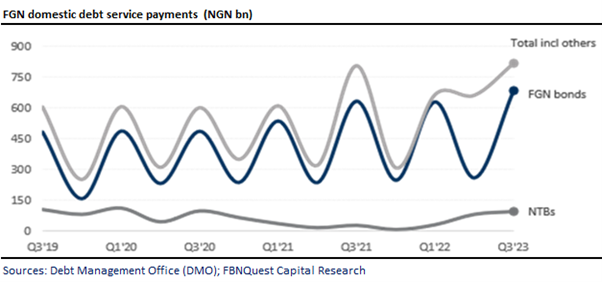
The Debt Management Office’s (DMO) latest quarterly release shows that the FG’s domestic debt service increased by NGN12bn, or 2% y/y to NGN821bn in Q3 ’22. Despite the modest rate of increase, debt-service payments during the quarter were the highest in recent times, as shown in our chart. The FG’s rapid accumulation of domestic debt over the last few years is a major factor behind the high cost of domestic debt service. On a y/y basis, the domestic debt obligations of the FG increased by 18% to NGN21.6trn, much faster than the 2% y/y rise in debt service payments.
On a cumulative basis, the total domestic debt service cost rose by 23% y/y to NGN2.2trn over the 9M ’22 (end-Sep) period.
A more recent presentation by the finance ministry puts domestic debt service cost for 11M ‘22 at NGN2.5trn, or roughly 70% of the total (ex-interest on ways and means) for the period.
Interest payments on FGN Bonds increased by NGN51bn to NGN686bn during the quarter and accounted for an 83% share of total debt service payments, up from 78% a year earlier.
A NGN2.3trn (17% y/y) increase in the value of FGN Bonds in the domestic debt portfolio to NGN15.8trn explains the higher share of interest payments for FGN Bonds.
Following difficulties with credit access on the international capital markets due to tight credit conditions, the FG had to rely primarily on domestic borrowings to plug its budget deficit.
Interest payments on Nigerian Treasury Bills (NTB) increased by 260% y/y to NGN95bn and were the second most significant component of domestic debt service.
Looking forward, the government’s debt profile is expected to rise steadily, leading to higher debt servicing costs.
According to the 2023 budget, the FGN intends to fund its fiscal deficit with additional domestic borrowings of NGN7.0trn out of total planned borrowings of NGN8.0trn.
We anticipate that the elevated market yields, which are likely to rise further, because of the FGN’s borrowing plans, will result in higher debt service costs in the future.