

Notably, mid-week sell pressures on MTNN (-3.6%), FBNH (-22.1%) and ACCESSCORP (-20.3%) caused a 0.8% w/w decline in the benchmark index to 62,569.73 points.
July 14, 2023/Cordros Report
Global Economy
Consumer prices in the United States (US) eased more than market expectations in June, leading to rising expectations that the US Feds may soon wrap up its interest rate hiking cycle. According to the Bureau of Labor Statistics (BLS), US headline inflation moderated by 100bps to 3.0% y/y in June (May: 4.0% y/y) – the lowest level since March 2021 (2.6% y/y). In our view, the better-than-expected consumer prices’ slowdown primarily reflects the high statistical base effects from the corresponding period of last year when the headline inflation rose to a 41-year high of 9.1% y/y. Accordingly, there was a broad-based price moderation across the food (5.7% y/y vs May: 6.7% y/y) and core (4.8% y/y vs May: 5.3% y/y) baskets. However, despite the diminishing consumer price pressures, we highlight that the core inflation remains above the headline reading, implying that broad inflationary pressures remain intact. In addition to the resilient labour market conditions, the preceding bolster arguments for an additional rate hike in the near term. Indeed, the market is currently pricing a 92.4% chance of a 25bps hike when the Fed meets on 26 July.
According to the National Bureau of Statistics of China, headline inflation was flat at 0.0% y/y in June (May: +0.2% y/y), reinforcing our view that more economic stimulus could be on the way as demand conditions remain underwhelming. The breakdown provided shows that the inflation reading was primarily due to a fall in non-food prices (-0.6% y/y vs May: 0.0% y/y), with transportation costs (-6.5% y/y vs May: -3.9% y/y) declining further in the review period. On a month-on-month basis, consumer prices remain in a deflationary terrain for the fifth consecutive month, falling by 0.2% m/m (May: -0.2% m/m). Looking ahead, we expect consumer prices to likely deflate in the near term, primarily due to the challenging base effects of the prior year amid underwhelming domestic demand and softer commodity prices. The preceding does not bode well for the Chinese economy, bolstering the need for monetary policy easing and more fiscal support to keep the economy afloat over the short term.
Global Markets
Global stocks rallied sharply this week as investors unwound bets on more aggressive rate hikes after softer-than-expected US inflation data. In line with this, US equities (DJIA: +2.0%; S&P 500: +2.5%) are on course for a weekly gain as investors cheered the prospects of the central bank taming inflation without tipping the economy into a recession. Likewise, positive sentiments supported European equities (STOXX Europe: +3.1%; FTSE 100: +2.5%) as investors welcomed the easing inflation momentum. Asian markets posted broadly bullish performances, with the Nikkei 225 (+0.2%) and SSE (+1.4%) posting gains as hopes of a Beijing stimulus package fueled a rally in tech stocks. Finally, the Emerging (MSCI EM: +4.1%) and Frontier (MSCI FM: +2.1%) market indices closed on a bullish note driven by gains in China (+1.4%) and Vietnam (+2.7%), respectively.
Nigeria
Domestic Economy
According to the National Bureau of Statistics (NBS), capital importation into Nigeria declined by 28.0% y/y to USD1.13 billion in Q1-23 (Q1-22: USD1.57 billion | Q4-22: USD1.06 billion). In general, we believe the year-on-year deterioration in the period reflects foreign investors’ lacklustre interest in the country given (1) an unclear foreign exchange framework, (2) an uninspiring macro narrative, (3) elevated global interest rates, and (4) heightened global uncertainties. Accordingly, capital inflows declined across foreign direct investments (-69.3% y/y to USD47.60 million), portfolio investments (-32.2% y/y to USD649.28 million), and other investments (-5.4% y/y to USD435.76 million). On a quarter-on-quarter basis, however, capital importation increased by 6.8%. While we think the recent policy pronouncements are positive and may boost foreign investor’s confidence over the medium term, we believe they will adopt a wait-and-see approach, for now, looking for signals on the CBN’s plans to start clearing the FX backlogs and boost FX supply to support the market in the near term. Thus, if local FX liquidity improves, market rates increase, and investors can easily repatriate capital, we expect foreign capital inflows to increase over the short-to-medium term.
According to the Nigerian Upstream Regulatory Commission (NUPRC), aggregate crude oil production (including condensates) increased for the second consecutive month, rising by 3.7% m/m to 1.48mb/d in June (May: 1.43mb/d). Parsing through the breakdown provided, we highlight that the Forcados (+12.7% m/m) and Egina (+3.5% m/m) oil terminals primarily drove the increase in the review period amid oil production decline in the Qua Iboe (-7.6% m/m) and Bonny (-13.7% m/m) streams. Overall, crude oil production averaged 1.38mb/d in Q2-23 – 8.9% lower than the 1.52mb/d average in Q1-23. Given the government’s efforts at curbing oil theft and pipeline vandalism, we expect crude oil production to maintain its slow increases in the near term. Thus, we estimate crude oil production to settle at 1.53mb/d in 2023E (FGN’s estimate: 1.69mb/d), indicating a higher oil production level relative to 2022FY production volume (1.37mb/d). Nonetheless, we think aggregate production is unlikely to reach the pre-pandemic high (c. 2.10mb/d) without investment in new production capacity. Consequently, we expect the government’s oil revenue performance to remain underwhelming over the short term.
Capital Markets
Equities
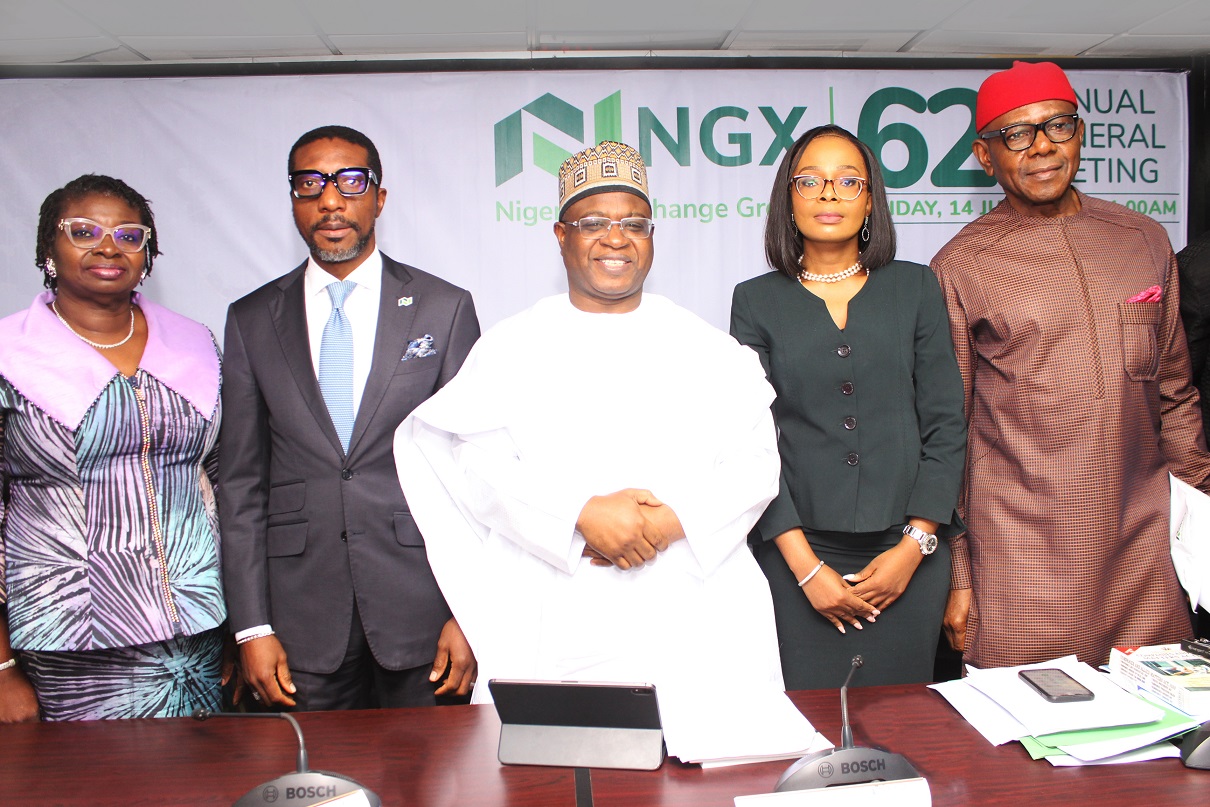
Although the domestic bourse started the week on a solid footing on positive reactions to DANGCEM’s share buy-back announcement, the bullish momentum lost steam as investors took a breather following the recent rallies. Notably, mid-week sell pressures on MTNN (-3.6%), FBNH (-22.1%) and ACCESSCORP (-20.3%) caused a 0.8% w/w decline in the benchmark index to 62,569.73 points. Based on the preceding, the Month-to-Date and Year-to-Date returns printed +2.6% and 22.1%, respectively. Likewise, activity levels were weak, as trading volume and value declined by 46.6% w/w and 56.4% w/w, respectively. Analysing by sectors, the Banking (-14.3%), Insurance (-11.5%), and Consumer Goods (-2.3%) declined, while the Industrial Goods (+9.0%) and Oil and Gas (+1.4%) indices closed in the green.
With the half-year earnings season on the horizon, we believe investors will look for clues on the sustainability of the decent corporate earnings released for Q1-23. However, we expect mixed market performance in the week ahead as bargain hunting on dividend-paying stocks will be matched by intermittent profit-taking activities. Overall, we reiterate the need for taking positions in only fundamentally sound stocks as the weak macro environment remains a significant headwind for corporate earnings.
Money market and fixed income
Money market
The overnight (OVN) rate expanded by 33bps w/w to 1.6%, as the average system liquidity this week settled lower at a net long position of NGN708.40 billion (vs a net long position of NGN782.85 billion in the previous week).
We believe that the OVN rate will head northwards in the upcoming week following the outflow from this month’s FGN bond auction, which is expected to mop up the surplus liquidity in the financial system, including the anticipated inflow from FGN bond coupon payments (NGN155.95 billion).
Treasury bills
Bullish sentiments persisted in the NTB secondary market, as the average yield across all instruments contracted by 3bps to 6.3%. Notably, this week’s bullish performance is attributable to the combined impact of (1) the healthy system liquidity and (2) market participants moving to the secondary market to compensate for lost bids at Wednesday’s NTB PMA. At the auction, the CBN offered NGN141.77 billion – NGN2.78 billion of the 91-day, NGN1.49 billion of the 182-day, and NGN137.50 billion of the 364-day – in bills. Total subscription at the auction settled at NGN691.86 billion (bid-to-offer settled at 4.9x) with more interest on the longer-dated bills (NGN654.62 billion translating to 94.6% of the total subscription). The auction closed with the CBN allotting precisely what was offered at respective stop rates of 2.86% (previously 2.87%), 3.50% (previously 4.37%), and 5.94% (previously 6.23%).
Given the expected lower liquidity in the system next week, we anticipate an increase in T-bills yields from current levels.
Bonds
In the same vein, trading activities in the Treasury bonds secondary market sustained its bullish momentum as investors continued to cherry-pick attractive bonds across the yield curve. As a result, the average yield contracted by 21bps to 12.7%. Across the benchmark curve, the average yield declined at the short (-25bps), mid (-8bps), and long (-28bps) segments, following market participants demanding the MAR-2025 (-59bps), APR-2032 (-15bps), and MAR-2036 (-75bps) bonds, respectively.
In the coming week, we expect the outcome of the July 2023 FGN bond auction holding on Monday (17 July) to influence the sentiments in the secondary market. At the auction, the DMO is set to offer instruments worth NGN360.00 billion through re-openings of the 14.55% FGN APR 2029, 14.70% FGN JUN 2033, 15.45% FGN JUN 2038 and 15.70% FGN JUN 2053 bonds. Nonetheless, we retain our view that frontloading of significant borrowings for the year by the FG will result in an uptick in bond yields as investors demand higher yields in the face of elevated supply.
Foreign Exchange
This week, Nigeria’s FX reserves decreased by USD2.01 million w/w to USD34.06 billion (12 July). Likewise, the naira depreciated by 3.4% to N803.90/USD at the I&E window (IEW), with total turnover at the window (as of 13 July 2023) decreasing by 22.0% WTD to USD343.69 million, as trades were consummated within the NGN690.00 – NGN818.00/USD band. In the Forwards market, the naira rates appreciated across the 1-month (+2.1% to NGN784.65/USD), 3-month (+1.7% to NGN806.80/USD), 6-month (+3.5% to NGN820.49/USD), and 1-year (+5.0% to NGN866.75/USD) contracts.
In the weeks ahead, we expect the re-introduction of the “willing buyer, willing seller” model at the IEW to influence the exchange rate direction. Nonetheless, while the CBN’s abolishment of its multiple FX windows is positive in boosting foreign investors’ confidence, we think they will adopt a wait-and-see approach, for now, looking for signals on the CBN’s plans to start clearing the FX backlogs and boosting FX supply to support the market in the near term.