August 3, 2023/FBNQuest
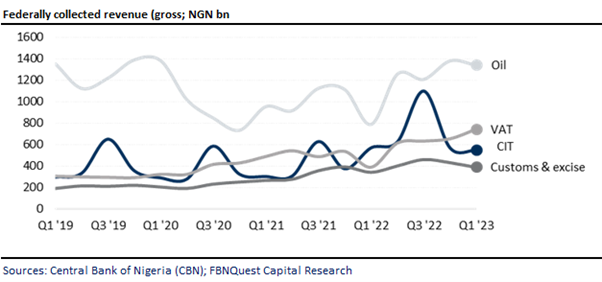
According to the CBN’s most recent Quarterly Statistical Bulletin, gross federally collected revenue for distribution to the three tiers of government declined slightly by -1% q/q to NGN3.0trn in Q1 ‘23. However, the federation’s gross revenue increased by +44% y/y. Underscoring the slight q/q drop in gross receipts was a modest decline in the collection of oil revenue to NGN1.3trn from NGN1.4trn in the previous quarter.
The decline in revenue from crude oil was mostly due to lower collections from royalties on oil & gas and penalties on flared gas, which decreased by -25% q/q and -21% q/q to NGN533.1bn and NGN12.9bn respectively.
However, excluding the Q4 ’22 crude oil revenue of NGN1.4trn, the Q1 ’23 receipts from crude oil represents the highest quarterly inflow for the past ten quarters.
The improved trend in crude oil performance is primarily due to concerted efforts by the security agencies to tackle crude oil theft and pipeline vandalism, which has continued to negatively impact the output of crude oil production.
For context, data from the Nigerian Upstream Petroleum Regulatory Commission shows that Nigeria’s average daily production of crude oil increased by 12% q/q to 1.28 million barrels per day (mbpd) in Q1 ’23 from c.1.15 mbpd the previous month.
Including condensates, the country’s average daily production of liquids was about1.52mbpd, up from 1.35mbpd in the previous quarter.
However, despite the increased crude oil output, the nation has not seen significant improvement in the fiscal outcome due to lower crude oil prices compared to last year.
In contrast to the modest reduction in oil revenue, non-oil revenue increased slightly by +1% q/q to NGN1.7trn in Q1 ’23.
The main factor which contributed to the modest rise was higher collection from value-added-tax (VAT), which increased by 14% q/q to NGN741.3bn.
On the other hand, customs and excise duties and companies’ income tax declined by -10% q/q and -4% q/q to NGN389.7bn and NGN546.2bn respectively.
Looking ahead, we expect the removal of fuel subsidies by the new administration to ease the fiscal pressure on the government.