




March 1, 2021/Proshare
By FBNQuest Research
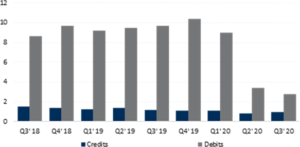
One of the core weaknesses of the Nigerian balance of payments is the permanent net outflow on the services account. There has been a short-term improvement in the past two quarters because of COVID-related restrictions across the world including a halt to international air traffic in Nigeria for much of the period. Nigerians made very limited use of the fx allowances for education, health and business travel related spending.
We see from the CBN’s Quarterly Statistical Bulletin that the net services deficit declined to USD1.82bn in Q3’20 from USD2.59bn the previous quarter and USD8.48bn in Q3’19. The narrative was similar in 2016 and early 2017, when the CBN practised effective fx rationing. Nigerians were then at least able to travel: it is just that they could not secure the allowances.
Travel debits collapsed to USD0.13bn in Q3’20, compared with the year earlier’s USD3.44bn. Education accounted for USD0.10bn (vs USD1.51bn in Q3,19) and the entry for health related spending in the bulletin is negligible (vs USD0.64bn).
The credits on the services account have declined during life with COVID-19 but at a far slower pace than the debits. The selective lockdown and subsequent restrictions would explain the modest decline. The figure of USD0.97bn in Q3’20 consisted largely of freight costs, other personal travel, and financial, government and insurance services. (The data show a consistent yet small surplus on government services.)
What Nigeria lacks are services industries that generate fx earnings. Examples from other jurisdictions include transportation (Ethiopia), medical tourism and outsourcing (India), recreational tourism (South Africa, Egypt, Senegal and Kenya), and offshore financial services (Mauritius).
The much reduced outflow on services has not brought a current-account surplus, which would have been the first since Q2’18 (Good Morning Nigeria, 18 February 2021). Merchandise imports have been more resilient than expected while net transfers (essentially workers’ remittances) have disappointed.
Once we have started to live “normally” with the virus in our midst and fx is again freely available, Nigerians will again draw on the authorized fx allowances and the deficit will return to previous levels. The latest improvement is therefore short-term. The net outflow averaged USD9.68bn per quarter in 2019.
Transactions on the services account (USD bn)

Sources: CBN; FBNQuest Capital Research

