

April 12, 2022/CSL Research
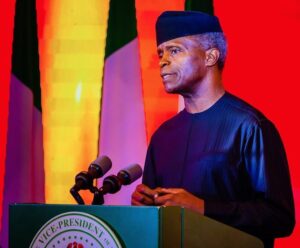
Yesterday, the Vice President, Yemi Osinbajo, formally declared his intentions to contest the 2023 Presidential elections under the ruling All Progressives Congress (APC). Transforming security, completing the reform of the judicial system, improving infrastructure and creating a technology-based economy were a few of the key projects on the agenda of the Vice President. Declaring his intentions to contest the presidential elections has changed the playing field as members of the ruling party have begun to pitch their tent with either the Vice President or the former Lagos State governor and national leader of the party, Bola Ahmed Tinubu, who had earlier declared his intentions to contest.
Given Tinubu’s political clout, getting the party ticket will be a keen contest. The Vice President, Yemi Osinbajo, is a Professor of law and a politician who previously served as Attorney General of Lagos State from 1999 to 2007 and holds the title of Senior Advocate of Nigeria. However, by standards of Nigeria’s political class, he can still be considered a political lightweight compared to his main counterpart, Bola Ahmed Tinubu.
While we would have expected the power of incumbency to be strong support, being a part of the present administration, the combination of weak macroeconomic conditions and worsening insecurity has put Nigeria in a precarious situation, which means his power of incumbency, may not confer the advantage it should. Besides Osinbajo and Tinubu, some other politicians that have declared intentions to contest the elections under the APC are David Umahi, the current governor of Ebonyi State, Yahaya Bello, the current governor of Kogi State and Rotimi Amaechi, current Minister of transportation. It is, however, safe to assume that the battle for the party ticket will be between Osinbajo and Tinubu.
Under the People’s Democratic Party (PDP), some of the politicians that have declared formal intentions to contest include former Vice President and two-time presidential aspirant Atiku Abubakar, former governor of Anambra State Peter Obi, the current governor of Rivers State, Nyesom Wike, the current governor of Sokoto State, Aminu Tambuwal, former Senate President, Olubukola Saraki, the current governor of Bauchi state, Bala Mohammed, the current governor of Akwa Ibom State, Emmanuel Udom, and Nigerian journalist, Publisher of Ovation Magazine, Dele Momodu. That said, it is still early stages, and one can safely assume that the playing field will likely change before 2023.
We expect the country’s 2023 presidential elections to be keenly contested. Though there will be many other candidates from other parties, we expect the presidential battle to be between the candidates of the People’s Democratic Party (PDP) and All Progressive Congress (APC). Nigerian politics is not based on competing ideologies but rival interests and ambitions, making it difficult to forecast what an APC or a PDP win will do for the economy. An easier way is to focus on the individuals contesting and not their party
affiliations, and based on that, Osinbajo appears a strong candidate.