



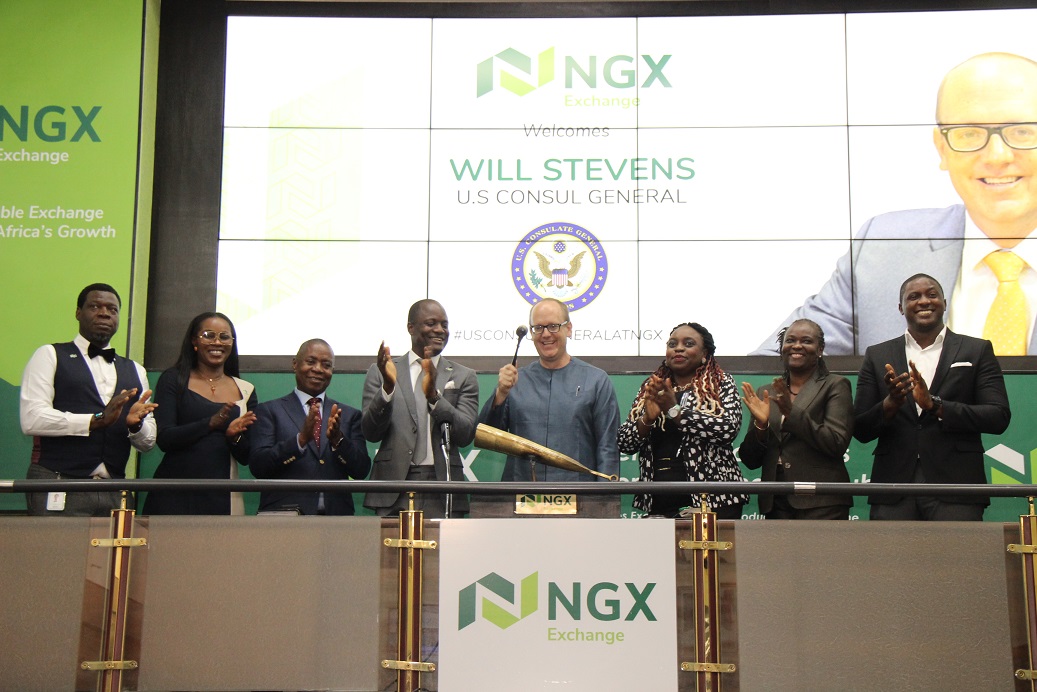
Though it was a shortened trading week, it was, however, enough for the local bourse to stage a come-back from its five-week bearish streak. Accordingly, the All-Share index advanced 0.5% w/w, to close at 47,569.04 points. Gains in BUACEMENT (+8.7%), and some tier-1 banks — GTCO (+5.3%), ACCESSCORP (+5.3%), and ZENITHBANK (+2.3%) – spurred the weekly gain.
October 14, 2022/Cordros Report
Global Economy
According to the Bureau of Labor Statistics (BLS), the United States headline inflation moderated for the third consecutive month, albeit above market expectation (8.1% y/y), easing by 10bps to 8.2% y/y in September (August: 8.3% y/y). Although prices remain at multi-decade highs, reflecting existing challenges, we highlight that a third consecutive month of moderation in energy prices was the primary driver of the slowdown in consumer prices in the review month. For context, the increase in energy prices eased to 19.8% y/y (August: 23.8% y/y). Furthermore, we note that cost pressures eased slightly in the cost of food (11.2% y/y vs August: 11.4% y/y) and used cars & trucks (7.2% y/y vs August: 7.8% y/y). On a month-on-month basis, consumer prices rose by 0.4% (August: 0.1% m/m). Although we expect that prices will moderate further in the near term, given the ease in energy prices, a resilient labour market poses an upside risk in the form of higher wage growth, keeping broad inflationary pressures intact. Accordingly, we expect the US Fed to maintain its tightening cycle in the short term.
According to the recently released data by the National Bureau of Statistics, China’s consumer prices increased by 30bps to 2.8% y/y in September (August: +2.5% y/y) – the highest level since April 2020 (3.3% y/y). We highlight that the increase in prices was primarily driven by higher food costs (8.8% y/y vs August: 6.1% y/y), which surged to its highest level in 25 months on account of accelerating pork prices (36.0% y/y vs August: 22.4% y/y). Elsewhere, the core inflation (1.5% y/y vs August: 1.7% y/y) eased following a slight moderation across the transport & communication (4.5% y/y vs August: 4.9% y/y), housing (0.3% y/y vs August: 0.6% y/y), and clothing (0.5% y/y vs August: 0.6% y/y) sub-baskets. On a month-on-month basis, consumer prices rose by 0.3 m/m in September (August: -0.1% m/m). We expect moderation in the country’s headline inflation in the near term, in line with the (1) government’s efforts to ease the rising cost of pork, (2) weak consumer demand amid intermittent lockdown, and (3) high base effects from the prior year.
Global Markets
Global stocks posted mixed performances as investors assessed the outlook for the Federal Reserve’s subsequent interest-rate hikes and the resilience of the US economy following the release of the latest (1) US inflation data, (2) retail sales data, and (3) corporate earnings reports. Accordingly, US (DJIA: +2.5% and S&P 500: +0.8%) stocks extended their winning streak to a second week as investors assessed earnings results from major banks for clues on the trajectory of the US economy. European equities (STOXX Europe: +1.1% and FTSE 100: -0.6%) posted mixed performances as investors reacted positively to prospects of a reversal in UK fiscal policy amid losses in financial stocks. In Asia, the Japanese market (Nikkei 225: -0.1%) declined following selloffs in heavyweight tech stocks earlier in the week. In contrast, the Chinese market (SSE: +1.6%) edged higher as slower-than-expected inflation data in China supported policy-easing bets. Elsewhere, the Emerging (MSCI EM: -4.8%) and Frontier (MSCI FM: -0.8%) markets settled lower on the back of losses in the Taiwanese (-4.2%) and Bahrani (-0.8%) markets, respectively.
Nigeria
Economy
Nigeria’s crude oil production continues to touch new lows, declining for the third consecutive month in September. According to the Nigerian Upstream Regulatory Commission (NUPRC), aggregate crude oil production (including condensates) declined by 3.6% m/m to 1.14mb/d in September (August: 1.18mb/d) – the lowest level since at least 1990. The persistent low crude oil production volume reflects the passthrough impact of (1) infrastructure decay, (2) massive oil theft and pipeline sabotage, and (3) IOC divestments, given the challenging business environment and the move to cleaner energy sources. Importantly, crude oil production declined significantly across the Bonny (-77.1% m/m), Forcados (-73.4% m/m) and Escravos (+17.1% m/m) production terminals. The consistent low crude oil production volume suggests that the oil GDP could drag overall growth in 2022FY amid the continued resilience of the non-oil sector. Overall, we do not expect a significant improvement in crude oil production over the short term, given the nature of challenges hampering production. Despite the rally in crude oil prices, we expect the government’s oil revenue performance to remain underwhelming over the short term.
According to the October edition of its World Economic Outlook (WEO), the International Monetary Fund (IMF) lowered its growth projection for Nigeria by 0.2ppts apiece for 2022E and 2023E to 3.2% y/y and 3.0% y/y, respectively. We note that the downward forecast primarily reflects (1) tighter monetary conditions, (2) lower trading partners’ growth, (3) low oil inflows amid reduced crude oil production, and (4) elevated inflationary pressures. Moreover, we highlight that the IMF downgraded sub-Saharan Africa’s growth outlook by 0.2ppts to 3.6% y/y in 2022E because of a negative shift in commodity terms of trade and tighter financial and monetary conditions. For us, we expect the Nigerian economic growth to slow to 3.01% y/y in 2022E (2021FY: 3.40% y/y) driven by a (1) sharper decline in crude oil production compared to the prior year and (2) slowdown in the non-oil sector’s growth as domestic activities normalise fully after the initial post-COVID boost. Accordingly, we expect the non-oil sector’s growth to moderate to 4.19% y/y (2021FY: +4.44% y/y) while we forecast the oil sector to contract further by 12.11% y/y (2021FY: -8.30% y/y).
Capital Markets
Equities
Though it was a shortened trading week, it was, however, enough for the local bourse to stage a come-back from its five-week bearish streak. Accordingly, the All-Share index advanced 0.5% w/w, to close at 47,569.04 points. Gains in BUACEMENT (+8.7%), and some tier-1 banks — GTCO (+5.3%), ACCESSCORP (+5.3%), and ZENITHBANK (+2.3%) – spurred the weekly gain. Consequently, the MTD and YTD returns settled at -3.0% and +11.4%, respectively. Activity levels were mixed, as trading volume declined by 16.2% w/w while value traded increased by 34.9% w/w. Analysing by sectors, the Industrial Goods (+3.2%), Banking (+1.9), and Insurance (+1.7%) indices advanced, while the Oil & Gas (-2.1%) and Consumer Goods (-0.7%) indices closed in the red.
In the week ahead, we believe investors will remain reluctant to leave gains in the market. As such, we expect intermittent profit-taking to persist. However, we expect this to be tempered by bargain-hunting activities from early birds ahead of the Q3-22 earnings season. Notwithstanding, we advise investors to take positions in only fundamentally sound stocks as the fragility of the macro environment remains a significant headwind for corporate earnings.
Money market and fixed income
Money market
The overnight (OVN) rate dipped this week by 75bps w/w to close at 16.5%, as inflows from NTB maturities (NGN190.89 billion) and OMO maturities (NGN10.00 billion) saturated system liquidity and overshadowed debits for CBN’s NTB and FX auctions. Nonetheless, we highlight that the average liquidity level for the week settled lower at a long position of NGN54.08 billion (vs a long position of NGN182.54 billion in the previous week).
We expect the OVN to trend upwards in the coming week, as funding pressures from the week’s auctions (FGN bond, OMO & FX) will likely offset the expected inflow from FGN bond coupon payments (NGN46.44 billion).
Treasury bills
The Treasury bills secondary market closed with mixed sentiments, albeit with bullish bias, as the average yield across all instruments pared by 1bp to 7.9%. We attribute this performance to participants moving to the secondary market to cover for lost bids at the NTB PMA. Across the segments, the average yield contracted by 2bps and 1bp to 10.3% and 7.3% at the OMO and NTB secondary markets, respectively. At Wednesday’s NTB PMA, the CBN offered bills worth NGN190.89 billion – NGN14.27 billion of the 91-day, NGN25.56 billion of the 182-day, and NGN151.06 billion of the 364-day – to market participants. That said, demand at the auction was skewed toward the long-dated bond, although the total subscription level settled lower at NGN111.94 billion (bid-to-offer 0.6x). Eventually, the CBN allotted NGN34.82 billion worth of bills to participants at respective stop rates of 6.47% (previously 6.49%), 7.90% (previously 7.50%), and 13.00% (previously 12.00%).
Following the thin inflows expected in the system next week, we anticipate a low demand for T-bills and a slight expansion in yields from current levels.
Bonds
Bearish sentiments persisted in the FGN bonds secondary market this week, as the average yield expanded by 21bps to 13.7%. We attribute this bearish sentiment to sell-offs across the mid and long spectrums as investors (1) reacted negatively to the Finance Minister’s debt restructuring comments and (2) took positions in anticipation of the October 2022 bond auction scheduled to hold next week Monday. Across the benchmark curve, the average yield contracted at the short (-3bps) end as investors demanded the MAR-2025 (-34bps) bond, but expanded at the mid (+50bps) and long (+18bps) segments, following the profit-taking activities on the NOV-2029 (+53bps) and JAN-2042 (+55bps) bonds, respectively.
We expect the outcome of the FGN auction holding on Monday (17 October) to shape the sentiments in the Treasury bond secondary market next week. At the auction, the DMO will offer instruments worth NGN225.00 billion through re-openings of the 14.53% FGN APR 2029, 12.50% FGN APR 2032 and 16.2499% FGN APR 2037 bonds. Notwithstanding, in the medium term, we maintain our view of an uptick in bond yields, as both the FGN’s borrowing plan for 2022FY and the expected fiscal deficit point towards an elevated supply.
Foreign Exchange
Nigeria’s FX reserve sustained its descent for the sixth consecutive week, falling to its lowest level since 5 October 2021. Precisely, the reserves declined by USD165.65 million w/w to USD37.91 billion (13 October 2022). Across the FX windows, the naira depreciated both at the I&E window (IEW) and parallel market by 0.5% and 1.1% to NGN441.38/USD and NGN743.00/USD, respectively. At the I&E window, total turnover (as of 13 October 2022) declined by 21.5% WTD to USD333.55 million, with trades consummated within the NGN414.00 – NGN464.55/USD band. In the Forwards market, the rate depreciated on the 1-month (-0.5% to NGN419.70/USD), 3-month (-0.7% to NGN455.41/USD), 6-month (-1.3% to NGN473.04/USD), and 1-year (-1.3% to NGN498.04/USD) contracts.
Although the CBN has enough liquidity to support the FX market over the short term, we highlight that foreign inflows are paramount for sustained FX liquidity over the medium term. Considering the tepid accretion to the reserves given the (1) low crude oil production level and (2) elevated PMS under-recovery costs, FPIs that historically supported supply levels in the IEW will be needed to sustain FX liquidity levels in the medium to long term. Hence, we think (1) further adjustments in the NGN/USD peg closer to its fair value and (2) flexibility in the exchange rate would be significant in attracting foreign inflows back to the market.

