
April 4, 2023/FBNQuest
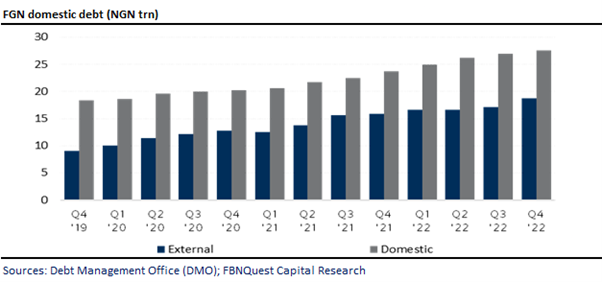
We see from the Debt Management Office’s (DMO) most recent data release on public debt that the FGN’s total domestic debt stock increased by 3% q/q and 15% y/y to NGN22.2trn (USD49.5bn) in Q4 ’22. With respect to share, the FGN accounts for an overwhelming share of the domestic debt at c.81% of total. In terms of proportion, the FGN accounts for an overwhelming share (81%) of the country’s total domestic debt stock. Its share is equivalent to roughly 11.1% of GDP. As shown by our chart, the debt burden has been rising steadily since Q4 ’18, with the slope steepening even more around Q4 ’20.
The FGN’s increased reliance on the domestic debt market to finance its fiscal deficits over the past few years as a result of the tight conditions on the international capital market is a reasonable explanation.
In terms of composition, FGN bonds accounted for almost 74% of the total debt stock, up from 73.2% in Q3 ’22, and 72.6% in the corresponding period of 2021.
Based on the DMO’s auction sales data, the agency sold around NGN2.8trn worth of FGN paper (ex-non-competitive bids in 2022), up from around NGN2.3trn in 2021.
Nigerian Treasury bills (NTBs) accounted for the second largest share of the FGN’s domestic debt stock at 20% of the total.
The balance of debt consists of smaller sums in Treasury bonds, savings bonds, Sukuk bonds, and promissory notes, totalling about NGN1.3trn, and representing 6% of The FGN’s total domestic debt.
On a pro-rata basis, the DMO has performed creditably well in meeting its domestic funding target of NGN7.7trn for the year. So far this year, the agency has raised almost NGN3.2trn, of which FGN bonds account for NGN2.0trn.
The FGN’s domestic debt burden is expected to increase significantly this year as the agency raises debt to plug the fiscal deficit of NGN10.8trn.