October 5, 2023/FBNQuest Research
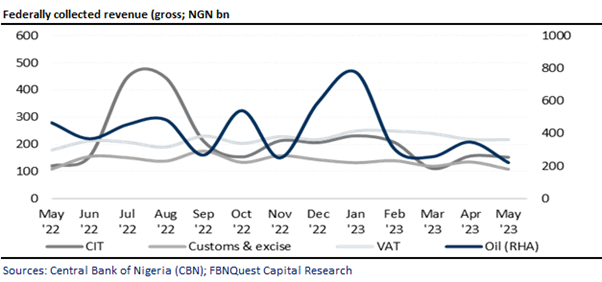
The CBN’s most recent monthly economic report showed that gross federally collected revenue declined by -16% m/m and -15% y/y to NGN837bn in May ’23. The revenue takes also represented a shortfall of -53% relative to the monthly revenue benchmark of NGN1.8trn. After deductions and transfers, and some additional revenue from other sources, mainly from excess non-oil sources, the balance left for distribution to the three tiers of government amounted to NGN656bn. On a cumulative basis, the federation’s gross revenue amounted to NGN5.3trn between Jan ’23 and May ’23, far below the implied budget target of NGN8.8trn.
Following recent patterns, the major contributor to the revenue weakness was the underperformance of oil revenue due to poor collection from petroleum profit tax.
Oil revenue fell by -36% m/m (-52% y/y) to a paltry NGN223bn, its worst performance since Feb ’22. The figure compares unfavourably with a monthly target of NGN804bn.
In comparison, non-oil revenue fell modestly to NGN614bn compared with the NGN649bn recorded for Apr ’23. However, it also fell short of the monthly benchmark of NGN961bn.
Revenue from value-added-tax (VAT) accounted for the largest share of non-oil revenue at 35.4%, or NGN217bn. While VAT revenue was flat m/m, it was 22% higher y/y.
Similarly, while revenue from companies’ income tax (CIT) also decreased modestly by -3% m/m, it increased by 27% y/y to NGN151bn.
In contrast, revenue from customs and excise duties decreased by a wider margin of -21% m/m to NGN107bn. The FGN’s independent revenue was flat m/m at around NGN136bn.
We have consistently observed that the federal government’s revenue projections tend to be overly ambitious. The recurring revenue shortfalls in comparison to the budgeted outcomes underscore this pattern.
Despite elevated oil prices, driven by factors like production curbs from Saudi Arabia and Russia, Nigeria will not fully reap the benefits.
As such, a key government priority is to boost oil production to around 1.7 mbpd (excluding condensates) from the current 1.2 mbpd, aiming to expand the fiscal space.